The £650 Halo: Hunting a Used 14-Inch MacBook Pro in 2026
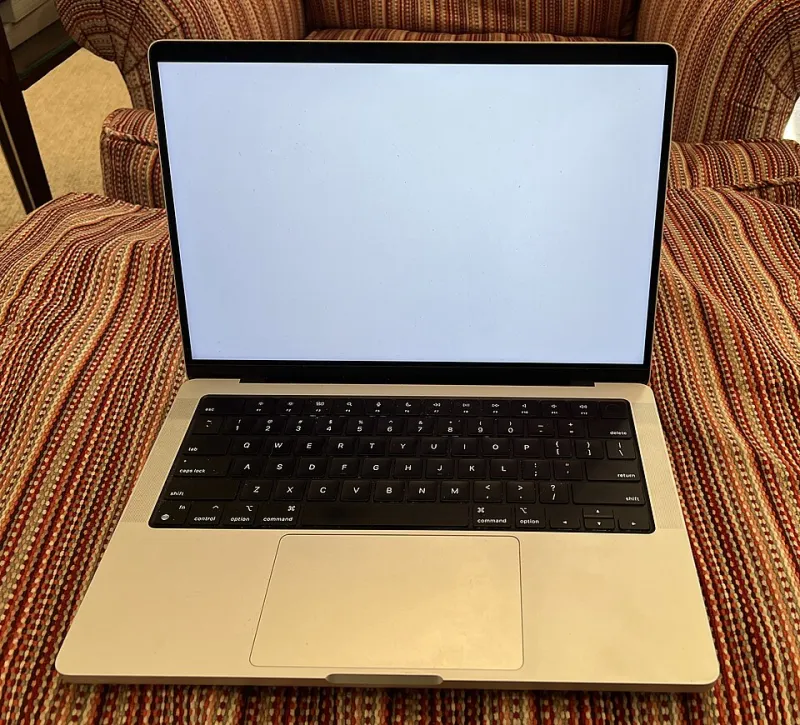
Photo: Oops4321, CC BY-SA 4.0, via Wikimedia Commons
The new MacBook Air is a lovely thing. It is also, depending on the configuration you stare at, a four-figure purchase in late 2026. Meanwhile, a clean second-hand 14-inch MacBook Pro from the M1 Pro or M2 Pro era is sitting in the £650–£1,000 band on UK marketplaces, and it comes with the sort of screen and port selection that makes the Air look positively Spartan.
That is the pitch, anyway. The reality is a bit more nuanced, which is why this guide exists. The 14-inch Pro is one of the smartest refurbished Apple buys going in 2026 — but only if you buy the right one, from the right sort of seller, after checking the right things.
Why this particular MacBook Pro became a bargain
Apple moved the 14-inch MacBook Pro to its own silicon in late 2021, and the M2 Pro refresh landed in early 2023. By November 2026, both are old enough to have fallen out of the spotlight and young enough to still feel modern. Ex-business leases, trade-ins and the usual upgrade cycle have pushed a steady supply into the UK refurb market.
The result is a machine that originally started around £1,899 sitting at roughly a third of that. You are not buying cutting-edge silicon. You are buying a very good chassis, a genuinely excellent display and a set of ports that Apple still refuses to put on the Air.
What £650 actually buys in November 2026
Let us set realistic expectations. A base M1 Pro 14-inch — 8-core CPU, 14-core GPU, 16GB of memory, 512GB of storage — is the model to hunt. Private sellers on eBay, Facebook Marketplace and Gumtree are listing healthy examples around £650–£800. A refurbisher with a proper warranty and a returns window will want £800–£900 for the same thing.
Step up to 1TB of storage and you are looking at £750–£900 privately. The M2 Pro version, which is a modest rather than dramatic jump, tends to sit around £900–£1,050. Above that, you are drifting into “why not just buy a new Air” territory.
Compare that with a new 13-inch MacBook Air M4 with 16GB and 256GB, which is a £999 conversation before any discounts. The Pro gives you more screen, more ports, more speakers and more sustained grunt for less money. The Air gives you less weight, a newer chip and a longer software horizon. That is the trade.
The screen is the headline act
The 14-inch Pro’s mini-LED display is the reason people struggle to go back. It is bright, it is smooth at 120Hz, and it handles HDR properly. The Air’s LCD is perfectly nice, but it is a 60Hz panel, and once you have used a ProMotion screen for a week, scrolling on an Air feels like someone has put treacle on the trackpad.
You also get HDMI, an SDXC card slot, three Thunderbolt 4 ports and MagSafe. That lot means fewer dongles for photographers, video people and anyone who plugs into a desk setup. The Air’s two Thunderbolt ports are fine until they are not.
And then there is the fan. The 14-inch Pro can hold a sustained load — an export, a compile, a long call — without throttling itself into a stutter. The fanless Air is silent and brilliant for bursts, but it is not the machine you buy for a 40-minute render.
The battery is where the bargain can bite
A used laptop’s battery is the single biggest variable. Check the cycle count and condition before you hand over any money. On the Mac, go to System Settings > Battery, or open System Information > Power for the raw numbers. A cycle count under 300 is fine. Around 500 you should be negotiating. Above 700, factor in a replacement.
Battery health above 85% is acceptable. Below 80%, you are buying a project. Apple’s own battery service for a 14-inch MacBook Pro is roughly £200–£250 out of warranty, so a cheap laptop with a tired battery is not actually cheap.
Also ask how the machine was charged. A life on a desk plugged into mains is gentler than daily 0–100% cycles, but it can still leave the battery sitting at 100% for years. CoconutBattery is a quick way to get a second opinion if you meet a seller in person.
Seller types, warranties and the UK safety net
Private sellers are where the £650 prices live, but you get very little comeback beyond the basics of the law. A trader — a refurbisher, CeX, Back Market, a proper eBay business seller — will charge more, but you get a warranty, usually 12 months, and a returns window.
Remember that UK consumer law gives you rights against a trader. The Consumer Rights Act 2015 says goods must be as described, of satisfactory quality and fit for purpose. You have a 30-day short-term right to reject, and for the first six months the burden is largely on the seller to prove the fault was not there at purchase. Distance selling also gives you 14 days to change your mind. None of that applies to a bloke in a car park.
Apple Certified Refurbished is the gold standard when stock appears, but 14-inch Pro models come and go. If you find one, you get a one-year Apple warranty and a new battery and outer shell. They are rarely the cheapest option, but they are the least stressful.
The checks that separate a bargain from a bad idea
Before you pay, confirm the serial number and check Apple’s coverage page. Make sure Activation Lock is off and the seller has signed out of iCloud and Find My. Ask whether it was ever enrolled in a mobile device management system — ex-corporate machines can arrive with a remote management profile that you cannot remove.
In person, run Apple Diagnostics, check every port, test the keyboard backlight, play something through the speakers and look for pressure marks on the screen. Open and close the lid slowly to feel the hinge. Bring a USB-C drive or an SD card and make sure it mounts. Check the charger is the correct 67W or 96W brick, not a random phone charger.
And do not assume you can add AppleCare+. Eligibility depends on the original purchase date, so check with Apple before you buy if that matters to you.
The Air is still the right answer for some people
If you carry a laptop every day, the Air’s 1.24kg versus the Pro’s 1.6kg is noticeable. If you want the longest possible software life, the M4 Air will outlast a 2021 M1 Pro by a couple of macOS generations. If your workload is browsing, writing and spreadsheets, the Air is more than enough.
But if you want the better screen, the ports, the speakers and the ability to work the machine hard without it wheezing, the used 14-inch Pro is the sweet spot. At £650–£750 for a clean M1 Pro, it is arguably the most computer per pound in the entire refurbished Apple market right now.
Set a ceiling, check the battery, verify the locks and buy from someone who will still answer the phone next week. Do that, and the halo is worth having.